
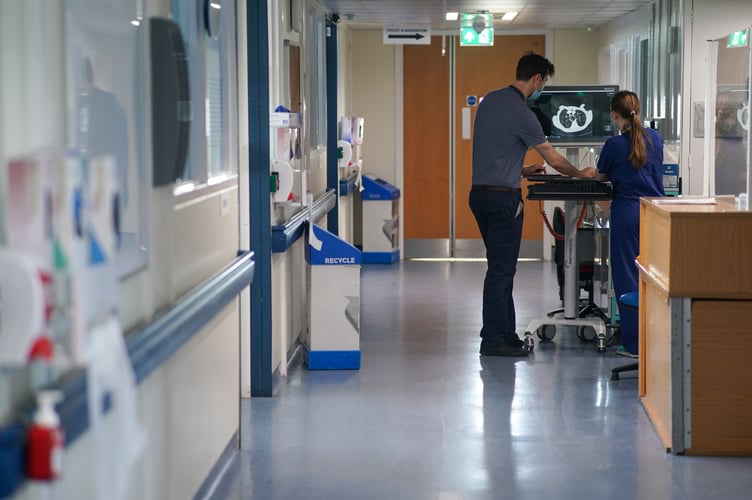
Tens of thousands of patients were waiting for routine treatment at the Royal Devon and Exeter Trust in May, figures show.
Junior doctors walked out on Thursday as part of five days of industrial action – amid record waiting lists across England.
NHS England figures show 75,969 patients were waiting for non-urgent elective operations or treatment at Royal Devon and Exeter NHS Foundation Trust at the end of May – down from 83,847 in April, and 84,804 in May 2022.
Of those, 7,153 (9%) had been waiting for longer than a year.
 One in 20 adults in Devon are lonely
 Tens of thousands of ultra low emission vehicles registered in Devon – as campaigners group call for more equal access across UKMore than 1,000 ultra low emission vehicles registered in West Devon – as campaigners group call for more equal access across UK
 Kate Bush tribute to 'dear friend' lost in Devon Christmas Day swim
The median waiting time from referral at an NHS Trust to treatment at the Royal Devon and Exeter Trust was 17 weeks at the end of May – up from 15 weeks in April.
Nationally, 7.5 million people were waiting to start treatment at the end of May.
Junior doctors walked out for five days from 7am on Thursday in the longest spell of industrial action in the history of the health service.
They return to work at 7am on July 18 and 48 hours later consultants are set to strike for two days. Radiographers across 43 NHS trusts will also walk out for two days from July 25.
Sir Julian Hartley, chief executive of NHS Providers, also called industrial action a “black cloud” hanging over the health service, which is currently in the “most challenging period of operational pressure”.
Separate figures show 1.6 million patients in England were waiting for a key diagnostic test in May – the same as in April.
At the Royal Devon and Exeter Trust, 15,680 patients were waiting for one of 13 standard tests, such as an MRI scan, non-obstetric ultrasound or gastroscopy at this time.
Of them, 6,375 (41%) had been waiting for at least six weeks.
Other figures show cancer patients at the Royal Devon and Exeter Trust are not being seen quickly enough.
The NHS states 85% of cancer patients urgently referred by a GP should start treatment within 62 days.
But NHS England data shows just 62% of patients urgently referred by the NHS who received cancer treatment at the Royal Devon and Exeter Trust in May began treatment within two months of their referral.
That was up from 60% in April, but equal to the proportion in May 2022 last year.
Dr Sarah Scobie, acting director of research at the Nuffield Trust think tank, said: "Figures this morning on NHS performance and GP patient experience illustrate clearly that there will be no sudden return to the waiting times the public have been promised and still expect".
"Yesterday's update from the NHS that it will adjust recovery targets on waits for planned operations is an acceptance of the difficult reality services now face with no end to doctor strikes in sight," she added.
Health and Social Care Secretary Steve Barclay said: "It is disappointing that the BMA is going ahead with further strike action. This five-day walkout by junior doctors will have an impact on thousands of patients, put patient safety at risk and hamper efforts to cut NHSwaiting lists."
A Department of Health and Social Care spokesperson said: “This Government is working to cut waiting times and the NHS is treating record numbers of patients each day."
“We have virtually eliminated 18-month waits, and are taking immediate action to improve urgent care, getting 800 new ambulances on the road, adding 5,000 hospital beds and scaling up virtual wards," they added.