

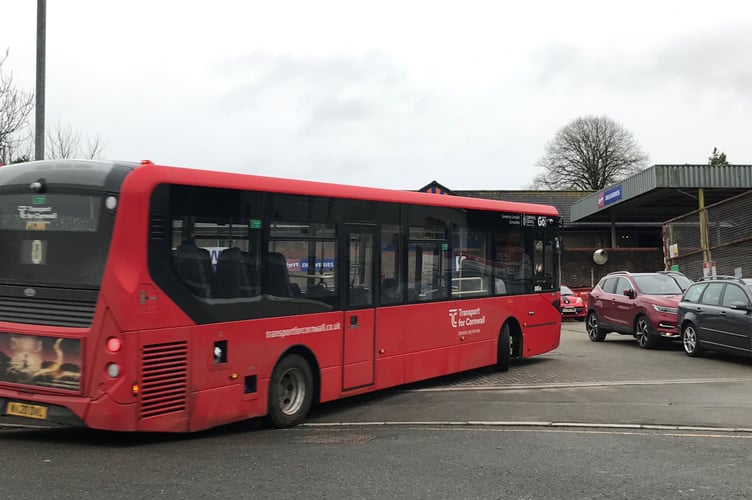
THE public has been urged to ‘use it or lose it’ after Go Cornwall bowed to public pressure to increase bus services between Callington and Tavistock.
From Sunday, September 4, the 79/79A service will increase from seven to 10 services a day Monday to Friday.
Go Cornwall said it had acted in response to numerous requests from passengers but said this increase would be reviewed if passenger numbers didn’t increase.
All changes have been made based on evidence of passenger use and in conjunction with Cornwall Council who subsidise the service, the bus company said.

.jpg?width=209&height=140&crop=209:145,smart&quality=75)


A statement on the Go Cornwall Bus website reads: ‘People aren’t using buses in the same way as they did before the pandemic, and so we’re revising which services are financially viable to make sure we can continue running bus services in the future.
‘All the journeys passengers make are analysed, so we can be sure we’re putting buses on the routes to suit the greatest number of people we can – this means that some routes will be running more frequently, while others will be reduced.’
In addition to more buses on the 79/79A route, the 235 trial service between Callington and Launceston is to be withdrawn due to low passenger numbers (whilst the 237 remains operational) and the 12/A hourly service between Plymouth and Callington via Saltash will be maintained. However, the route between Callington and Launceston is to be reduced to services every two hours.
The new running of the 79/79A service, which is scheduled to run up to ten times a day between Tavistock and Callington on weekdays, was initally met with confusion and upset by some local residents and councillors.
This was because an error on the Go Cornwall Bus online timetable incorrectly stated that there would be no buses stopping on the the the 79 service in rural Harrowbarrow, Metherell and Calstock in time to get children to school in either Tavistock or Callington on time.
In face, this is not the case, as the company has now clarified, and the website had incorrect information. This has now been updated.
Richard Stevens, managing director of Go Cornwall Bus, said: ‘We apologise for the confusion caused by a website glitch. We tried to increase the notice period available for passengers to learn about upcoming September service changes; regrettably the website has not presented the school term journeys correctly, and the information has been withdrawn from the website to prevent continued confusion.
‘The current 79/79A term time timetable has been enhanced with two additional round trips added. To clarify, we are still providing services to allow students to get to and from school – Services 79 and 174 will cover Tavistock Bus Station, Callington Community College and Callywith College, including Harrowbarrow, the Rising Sun and Calstock.
‘We regret the angst this has caused people worried about the 79/79A. We’d encourage people to use the bus, especially service 79/A, as the more passengers we have, the more able we are to run a comprehensive service in the future.’
The increased running of the service has been welcomed by Cornwall Councillors for Calstock Dorothy Kirk and Callington and St Dominick Andrew Long, who have previously criticised Cornwall Council for making decisions, as what he has described as a ‘Truro-centric authority’, leaving residents of South East Cornwall feeling like ‘second-class citizens’.
Dorothy Kirk said: ‘Essentially, this is about money, which bus companies have lost out on during the pandemic. Services will be put in place based on financial viability, yet we all pay council tax and need services which are essential to those of us in rural areas such as children who must get to school or those reliant on buses to get to work.
‘This change demonstrates the successful outcome that arises from local residents putting pressure on portfolio holder for transport Philip Desmonde. In the past, our needs have been less obvious in South East Cornwall than to those in Truro.’
Cllr Long has recently campaigned vehemently against ‘discriminatory’ decisions affecting South East Cornwall residents reliant on bus services to be revisited and overturned.
He pointed out that the bus fares pilot scheme providing much reduced fares, financed by Cornwall Council with a £32-million government grant, had not been applied to services crossing the border into Devon, such as the 79 and 79A, which people in the Calstock and Callington areas rely on to access hospitals and medical services and schools in Tavistock and Plymouth.
Comments
This article has no comments yet. Be the first to leave a comment.